MemoHoney Official Website › Articles › The formula
The formulaMemoHoney Nootropic Claims: Why a Memory Capsule Is Full of Sports-Nutrition Ingredients
MemoHoney’s nootropic case is untested: no trial has given MemoHoney, or its six ingredients together, to people and measured memory. Five of the six named ingredients are nitric oxide and sports-nutrition ingredients: two arginine forms, two citrulline forms and beta-alanine. The blood-flow argument for them is coherent, but their trials used grams a day of one ingredient at a time, and the distributor says most buyers wait 4 to 8 weeks.
The list, and what it looks like to somebody who reads labels
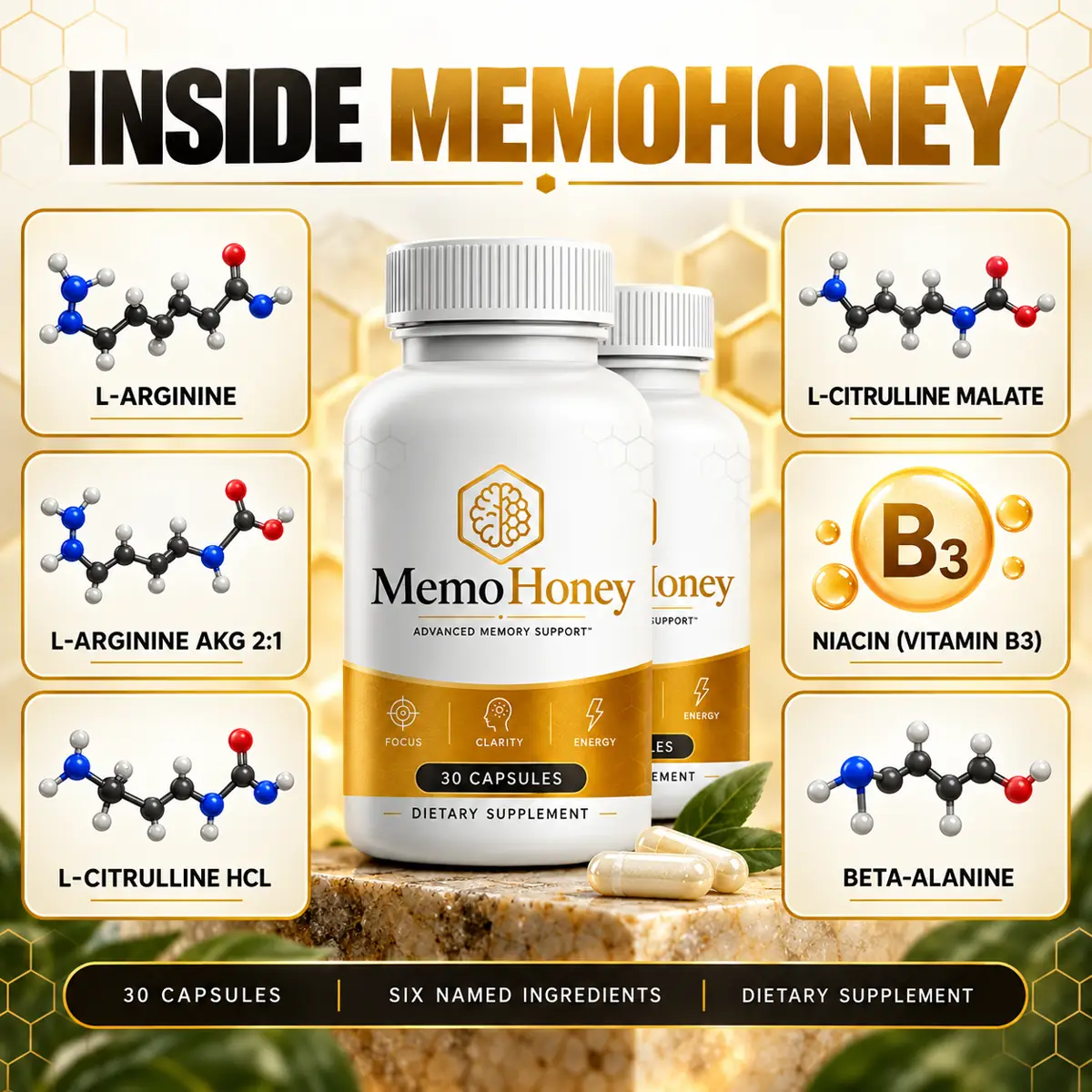
MemoHoney names six ingredients: L-arginine, L-arginine AKG 2:1 extract, L-citrulline HCl, L-citrulline malate, niacin and beta-alanine. Show that list to anyone who has spent time in a supplement shop and five of the six will land immediately, and not on the memory shelf.
Arginine, arginine AKG, citrulline in two forms and beta-alanine are pre-workout ingredients. They appear in powders sold to cyclists and weightlifters, usually at doses measured in grams and usually mixed into a drink twenty minutes before training. Finding all five inside a capsule sold for recall is genuinely unusual, and it is the most interesting thing about this label.
MemoHoney is a dietary supplement and not a treatment for anything. Nothing here is medical advice. Memory that has changed in a way you or the people around you have noticed is worth an appointment rather than a purchase, and MedlinePlus sets out what is worth reporting.
The argument that puts them there
There is a reason, and it is not a bad one. The brain is an expensive organ. It runs on a continuous supply of oxygen and glucose, and how much arrives depends on how wide the vessels carrying it are. Vessel width is regulated by nitric oxide, a gas made in the vessel lining that relaxes the smooth muscle wrapped around it.
Nitric oxide is made from arginine. That single fact is the whole of the blood-flow argument, and it is why this label reads the way it does. Take more arginine, the reasoning runs, make more nitric oxide, widen the vessels, deliver more fuel to the tissue, think more clearly.
The complication is that swallowed arginine mostly does not arrive. A stable-isotope study of a labelled arginine meal followed it through the gut wall and the liver and showed how much is consumed before it reaches the circulation. That is why the rest of the list exists: citrulline is absorbed intact and converted to arginine in the kidney, downstream of those losses, which a 2026 pharmacokinetic characterisation quantified in detail.
Where these ingredients were actually studied
The useful question is not whether the pathway is real, because it is. It is what happened when somebody gave these ingredients to people and measured something. Here is what the trials behind each name actually looked at.
| Ingredient | What a published trial measured | In whom |
|---|---|---|
| L-Arginine | muscle endurance and blood pressure during resistance training | Trained adults |
| L-Arginine AKG | blood flow and plasma arginine after resistance exercise | Trained men |
| L-Arginine AKG | muscular performance after an acute dose | Resistance-trained and untrained men |
| L-Citrulline HCl | cerebrovascular function during sprint intervals | Taekwondo athletes |
| L-Citrulline Malate | repeated sprint running | Male team-sport athletes |
| Beta-Alanine | exercise capacity and performance | Pooled across dozens of sports trials |
Six trials, six exercise outcomes. Not one of them measured recall, attention or anything a reader would call memory.
Two of those six are null results, and they are in the table for the same reason the positive ones are. Arginine AKG at 3 g before a single session changed nothing measurable, and seven days at 12 g a day did not improve blood flow either. An ingredient with two null trials behind it is still on this label, which is worth knowing.
The closest thing to cognitive evidence
Two of the six do have something. They are worth separating out because they are the honest answer to anyone asking whether this list has any connection to the brain at all.
Citrulline and cerebral blood flow
One trial has measured anything cerebral. It gave 8.8 grams of citrulline a day for five days to taekwondo athletes and measured cerebrovascular response during sprint interval training. That is a real measurement on a real brain, and it is a very long way from a name arriving faster at a dinner party. The dose is roughly ten times what a shared capsule could hold.
Beta-alanine and the hippocampus
The other is more interesting. A randomised trial in men and women aged 60 to 80 gave 2.4 grams of beta-alanine a day and reported improved fractional anisotropy scores in the hippocampus and amygdala on diffusion imaging. A separate trial gave carnosine at 2 grams a day and reported improved cognitive outcomes in younger participants. Both are small, both are interesting, and both used gram doses of a single ingredient.
A plausible mechanism, one cerebral blood-flow measurement in athletes, and one imaging trial in older adults. That is a more respectable evidence base than most of the memory shelf carries, and it is nowhere near a demonstration that a six-ingredient capsule improves anybody's recall.
Read the MemoHoney ingredient list with the trials attached
Every one of the six names is printed on the ingredients page beside the amount its own research used, the population it was given to and what was measured.
Two bottles $158 · six bottles $294 · 60-day money-back guarantee
Order MemoHoney From This CounterLot MEM-26/MA-5403 · one each morning, 30 to a bottle · ships from the United States
The one ingredient that is not from the gym
Niacin is the odd name out and it belongs to a different argument entirely. It is a B vitamin, converted in the body to NAD and NADP, the two coenzymes that carry electrons through energy metabolism. Every cell uses them, neurons included.
Its link to cognition comes from diet rather than from supplements. The Chicago Health and Aging Project followed dietary niacin intake against incident Alzheimer's disease and cognitive decline over years of follow-up, and a 2025 observational analysis of B vitamin intake in older adults reports in the same tradition. Observational work of that kind is useful for generating a hypothesis and poor at proving one.
Niacin is also the only ingredient on this label whose useful amount fits comfortably inside a capsule, and the only one with a published ceiling: the US tolerable upper intake level is 35 mg a day, worked out in a systematic review of the dose-response for flushing. Which makes the missing panel more frustrating here than anywhere else on the label, because this is the one number that could have been checked.
So is a sports formula in a memory bottle a problem
Not in itself. Ingredients do not belong to categories; they do things, and the thing these do is vascular. If widening cerebral vessels helped recall, this would be a sensible list.
Three things make it harder to be enthusiastic, and they are worth stating in order.
- Nobody has shown that a vascular change of this size produces a cognitive change. Blood pressure is not recall, and cerebral blood flow during a sprint interval is not recall either.
- The amounts that produced the vascular results are between 2.4 and 12 grams a day of one ingredient. A capsule shared between six cannot carry any of them.
- The label prints no amounts at all, so a reader cannot check how far short it falls. That is a disclosure problem rather than an ingredient problem, and it is the one that matters most.
What that adds up to is a formula with a coherent idea behind it and no way to verify its execution. Worth knowing before buying rather than after, which is why it is on this blog and in the ingredients page rather than tucked into a footnote.
How to spot this pattern on any other bottle
A memory product built out of blood-flow ingredients is not unique to this brand, and the pattern is easy to recognise once you have seen it. Three tells do most of the work.
- The ingredient names end in -ine and appear in pre-workout powders: arginine, citrulline, beta-alanine, taurine, nitrate from beetroot.
- The sales copy leans on circulation language: oxygen, blood flow, delivery, vasodilation, the brain as an organ that needs fuel.
- The citations, where there are any, are exercise trials. Look at the population in the abstract: athletes, trained men, resistance-trained adults.
None of those three makes a product bad. Together they tell you which literature to go and read, which is genuinely useful, because the exercise literature on these ingredients is large and generally well conducted. What it will not contain is a cognitive outcome.
The second half of the check is the amount. Pre-workout doses are grams, and a memory capsule is milligrams, so the two are never doing the same thing even when they share an ingredient list. Where a panel is printed, that comparison takes about a minute per ingredient.
What to do with that
- Read the six names against the trial amounts on the ingredients page before deciding.
- If you already take a pre-workout with citrulline or beta-alanine in it, read both labels side by side: the overlap is substantial.
- If you take a nitrate or a blood-pressure medicine, show the six names to whoever prescribes them. Five of the six act on the same pathway.
- Give it the four to eight weeks the distributor's own summary describes, and use the refund window if it does nothing.
And if you are looking for the best-evidenced thing you could do for memory this month, it is not on this label: treating hearing loss has the largest randomised result in this whole conversation, and nobody sells it in a bottle.
- Printed in 2013, “Kinetics of the utilization of dietary arginine for nitric oxide and urea synthesis: insight into the arginine-nitric oxide metabolic system in humans” (Mariotti F, Petzke KJ, Bonnet D, et al; Am J Clin Nutr, 97(5):972-9) — PubMed record 23535108.
- Printed in 2026, “Quantitative characterization of L-citrulline as a precursor of L-arginine in rats: pharmacokinetic basis for nitric oxide-mediated effects” (Song S, Thapa SK, Upadhyay M, et al; Front Pharmacol, 17:1889835) — PubMed record 42755674.
- Printed in 2025, “The effects of L-citrulline supplementation on cerebrovascular function during sprint interval training in taekwondo athletes” (Li A, Li H, Chen J; J Exerc Sci Fit, 23(3):222-228) — PubMed record 40474881.
- Printed in 2024, “β-Alanine supplementation improves fractional anisotropy scores in the hippocampus and amygdala in 60-80-year-old men and women” (Ostfeld I, Zamir A, Ben-Zeev T, et al; Exp Gerontol, 194:112513) — PubMed record 38971131.
- Printed in 2004, “Dietary niacin and the risk of incident Alzheimer's disease and of cognitive decline” (Morris MC, Evans DA, Bienias JL, et al; J Neurol Neurosurg Psychiatry, 75(8):1093-9) — PubMed record 15258207.
- Printed in 2017, “Definition of a tolerable upper intake level of niacin: a systematic review and meta-analysis of the dose-dependent effects of nicotinamide and nicotinic acid supplementation” (Minto C, Vecchio MG, Lamprecht M, et al; Nutr Rev, 75(6):471-490) — PubMed record 28541582.
- Printed in 2023, “Hearing intervention versus health education control to reduce cognitive decline in older adults with hearing loss in the USA (ACHIEVE): a multicentre, randomised controlled trial” (Lin FR, Pike JR, Albert MS, et al; Lancet, 402(10404):786-797) — PubMed record 37478886.
- MedlinePlus, US National Library of Medicine: “Memory” — medlineplus.gov.