MemoHoney Official Website › MemoHoney Ingredients
MemoHoney IngredientsMemoHoney Ingredients: the six names and what each one was tested at
Six ingredients are named on the artwork: L-Arginine, L-Arginine AKG 2:1 Extract, L-Citrulline HCL, L-Citrulline Malate, Niacin (Vitamin B3) and Beta-Alanine. No amount is given for any of them, because the supplied artwork has no Supplement Facts panel. This page gives each name, what it is, and the amount its own published trials used.
Five of the six come from nitric oxide and sports nutrition research. One is a B vitamin. Here is each of them with its evidence attached.
The six names printed on the MemoHoney artwork
One graphic carries the whole ingredient statement, and it agrees with the seller's page name for name.
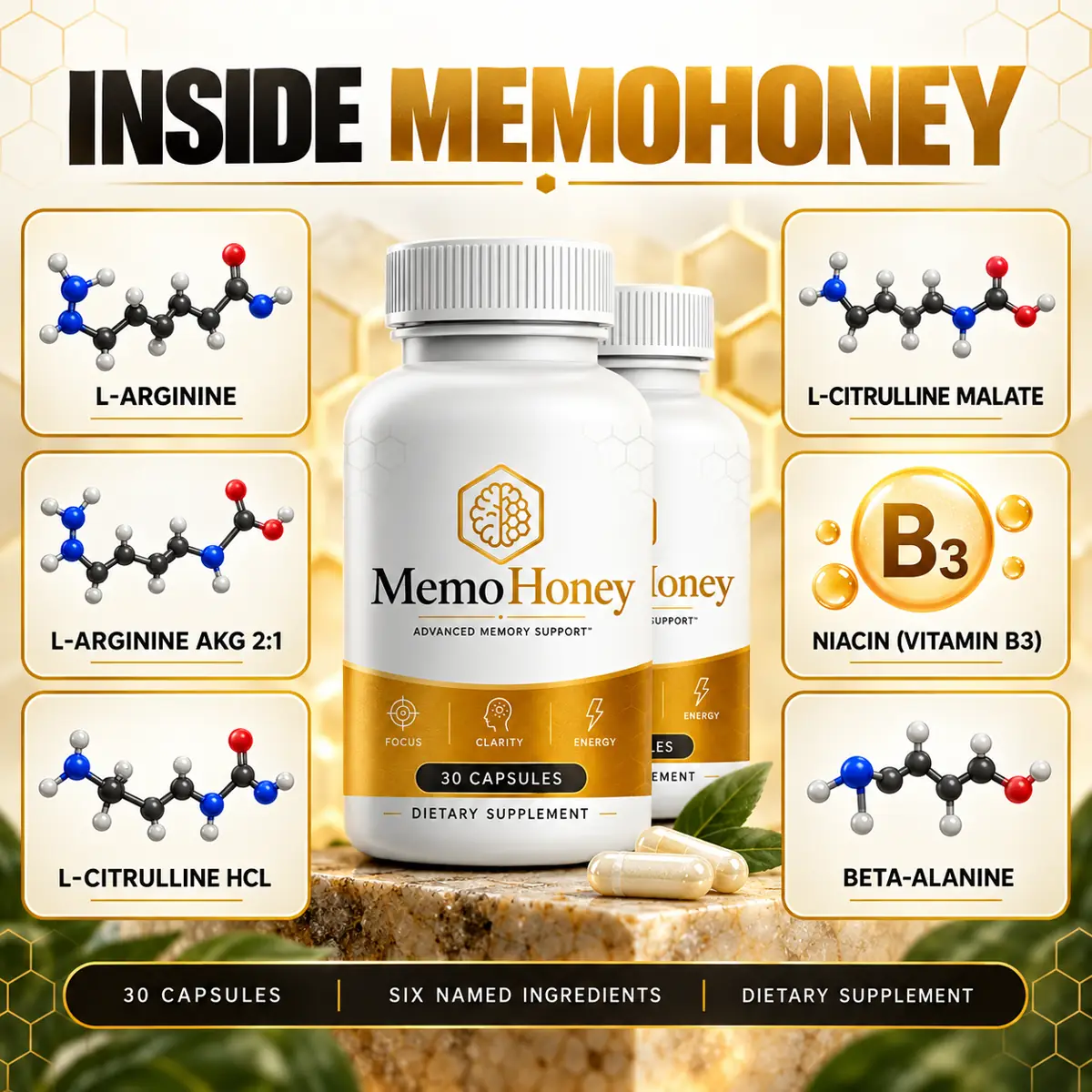
The vendor's tile graphic is the clearest statement of the formula anywhere in the pack. Six tiles, six names, a molecular diagram on each, and a closing strip reading thirty capsules, six named ingredients, dietary supplement.
Those six match the seller's published list exactly, in the same order. Where a lot of labels in this category shorten a list on the bottle and lengthen it on the sales page, this one does not, and that consistency is worth noting before the harder part of the page.
- L-Arginine, amino acid
- L-Arginine AKG 2:1 Extract, amino acid salt
- L-Citrulline HCL, amino acid salt
- L-Citrulline Malate, amino acid salt
- Niacin (Vitamin B3), vitamin
- Beta-Alanine, amino acid
Every MemoHoney ingredient, with the research behind it
What each one is, what it was given at, and which literature the number comes from.
L-Arginine
amino acidAmount on the artwork: not givenThe amino acid the body converts into nitric oxide, the molecule that relaxes the muscle in a vessel wall and widens it. Most of a swallowed dose is broken down in the gut wall and the liver before it reaches the bloodstream, which is the single fact that shaped everything that came after it in this list.
Studied at: One labelled meal in the kinetic study; supplement trials work in grams. Field that ran it: Blood pressure and exercise. Source: a stable-isotope study of dietary arginine.
L-Arginine AKG 2:1 Extract
amino acid saltAmount on the artwork: not givenTwo parts arginine to one part alpha-ketoglutarate, a salt borrowed from the pre-workout shelf on the argument that it clears the gut better than arginine on its own.
Studied at: 4 g three times a day, 12 g in total, in the pharmacokinetic trial. Field that ran it: Resistance training. Source: the arginine AKG pharmacokinetic trial.
L-Citrulline HCL
amino acid saltAmount on the artwork: not givenCitrulline slips past the gut and liver losses that catch arginine and is converted to arginine in the kidney, so it raises plasma arginine more dependably than swallowing arginine does.
Studied at: 8.8 g a day for five days in the cerebral blood-flow trial. Field that ran it: Cerebral blood flow during hard exercise. Source: the citrulline cerebrovascular trial.
L-Citrulline Malate
amino acid saltAmount on the artwork: not givenThe same citrulline paired with malic acid, an intermediate in the cycle cells use to make energy. It is the form the sports literature reaches for most often.
Studied at: 8 g a day for three days; 8 g and 12 g compared head to head. Field that ran it: Repeated sprints and lower-limb work. Source: a three-day citrulline malate trial.
Niacin (Vitamin B3)
vitaminAmount on the artwork: not givenThe B vitamin the body turns into NAD and NADP, the two carriers that move electrons through energy metabolism. Prolonged deficiency causes pellagra, and the third of its three classical symptoms is dementia.
Studied at: Dietary intakes in the low tens of milligrams a day. Field that ran it: A long-running observational cohort. Source: the Chicago Health and Aging Project analysis.
Beta-Alanine
amino acidAmount on the artwork: not givenThe slower half of carnosine, a two-amino-acid molecule that buffers acid inside muscle and turns up in brain tissue as well. Supplying beta-alanine is how carnosine levels are raised.
Studied at: 2.4 g a day for the brain-imaging trial; 3.2 to 6.4 g in sport. Field that ran it: Exercise capacity, plus one small imaging study. Source: the beta-alanine brain-imaging trial.
Why the MemoHoney list reads like a sports formula
The reasoning that puts five sports-nutrition ingredients in a memory bottle, and the point where that reasoning runs out.
Put the six names in front of anyone who reads supplement labels and they will place five of them immediately: arginine, arginine AKG, citrulline HCl, citrulline malate and beta-alanine are pre-workout ingredients. They are on this label because of a single, defensible idea, which is that a brain runs on blood and the nitric oxide pathway is how vessel width is regulated.
The pathway itself is textbook. Arginine is the substrate for nitric oxide; most of an oral dose never gets there, which a stable-isotope study traced through gut and liver metabolism; citrulline is converted to arginine downstream of those losses and does the job better, which a 2026 pharmacokinetic characterisation quantified. The outcome evidence in humans is vascular and muscular: citrulline lowers blood pressure in middle-aged and older adults, and a review of older adults sets out where it helps alongside exercise training.
What does not exist is a trial connecting that pathway to recall in humans taking a capsule. The one study that measured anything cerebral gave 8.8 g of citrulline a day for five days to taekwondo athletes and looked at blood flow during sprint interval training. That is a long way from a name arriving faster at a dinner party, and nothing on this page pretends otherwise.
On a label whose ingredients were studied in milligrams, a missing panel is annoying. On a label whose ingredients were studied in grams, it is the whole question, because the gap between what a capsule can hold and what the trials used is several orders of magnitude wide. That is why this site prints the trial amount beside every name rather than leaving the column blank.
MemoHoney ingredient amounts against the published trials
Two columns, side by side, with no arithmetic done on the reader's behalf.
The right-hand column is not a target this product is failing to hit. It is context: these are the amounts at which each ingredient produced a measurable result in a controlled study, in a population chosen for that study. A once-daily capsule is a different proposition and should be judged as one.
Niacin is the row to read twice. It is the only ingredient here whose effective amount is a milligram figure, and it is also the only one with a published ceiling: 35 mg a day in the United States, worked out in a systematic review of the dose-response. A panel would settle in one line whether this capsule sits at 10 mg or 40 mg, and whether it stacks safely with a multivitamin. Without one, that question stays open.
What is not named on the MemoHoney label
The shell, the excipients the artwork does not name, and the families of ingredient that are absent.
The capsule shell is hypromellose, a plant cellulose material, which is what the seller points at when asked whether the product suits vegetarians. Beyond the six actives and the shell, the artwork names no excipient at all.
A finished capsule almost always contains something besides its actives: a flow agent so the powder fills evenly, sometimes a bulking agent, occasionally an anti-caking material. None of that is sinister and most of it is inert. The practical point is narrower. Anyone avoiding a specific excipient for a medical reason will not be able to clear this label from the artwork alone and should call the order desk on +1 (302) 200-3480 before buying.
There is also nothing on this label that belongs to the stimulant family. No caffeine, no synephrine, no yohimbine, and no nootropic drug. That is worth stating positively, because the category has a history: an analysis of cognitive-enhancement supplements identified the unapproved drug centrophenoxine in products sold in the United States as dietary supplements. Six amino acids and a B vitamin is a conservative list by the standards of that literature.
How this MemoHoney ingredient page is checked
Every source named above, with the record it came from.
- Mariotti F, Petzke KJ, Bonnet D, et al. Kinetics of the utilization of dietary arginine for nitric oxide and urea synthesis: insight into the arginine-nitric oxide metabolic system in humans. Am J Clin Nutr. 2013;97(5):972-9. PMID 23535108. https://pubmed.ncbi.nlm.nih.gov/23535108/
- Song S, Thapa SK, Upadhyay M, et al. Quantitative characterization of L-citrulline as a precursor of L-arginine in rats: pharmacokinetic basis for nitric oxide-mediated effects. Front Pharmacol. 2026;17:1889835. PMID 42755674. https://pubmed.ncbi.nlm.nih.gov/42755674/
- Luo P, Chen J, Liu K, et al. Does l-citrulline supplementation and watermelon intake reduce blood pressure in middle-aged and older adults? A systematic review and meta-analysis of randomized controlled trials. Clin Nutr ESPEN. 2025;69:653-664. PMID 40789388. https://pubmed.ncbi.nlm.nih.gov/40789388/
- Figueroa A, Jaime SJ, Morita M, et al. L-Citrulline Supports Vascular and Muscular Benefits of Exercise Training in Older Adults. Exerc Sport Sci Rev. 2020;48(3):133-139. PMID 32568925. https://pubmed.ncbi.nlm.nih.gov/32568925/
- Li A, Li H, Chen J. The effects of L-citrulline supplementation on cerebrovascular function during sprint interval training in taekwondo athletes. J Exerc Sci Fit. 2025;23(3):222-228. PMID 40474881. https://pubmed.ncbi.nlm.nih.gov/40474881/
- Minto C, Vecchio MG, Lamprecht M, et al. Definition of a tolerable upper intake level of niacin: a systematic review and meta-analysis of the dose-dependent effects of nicotinamide and nicotinic acid supplementation. Nutr Rev. 2017;75(6):471-490. PMID 28541582. https://pubmed.ncbi.nlm.nih.gov/28541582/
- Morris MC, Evans DA, Bienias JL, et al. Dietary niacin and the risk of incident Alzheimer's disease and of cognitive decline. J Neurol Neurosurg Psychiatry. 2004;75(8):1093-9. PMID 15258207. https://pubmed.ncbi.nlm.nih.gov/15258207/
- Ostfeld I, Zamir A, Ben-Zeev T, et al. β-Alanine supplementation improves fractional anisotropy scores in the hippocampus and amygdala in 60-80-year-old men and women. Exp Gerontol. 2024;194:112513. PMID 38971131. https://pubmed.ncbi.nlm.nih.gov/38971131/
- Cohen PA, Avula B, Khan I. The unapproved drug centrophenoxine (meclofenoxate) in cognitive enhancement dietary supplements. Clin Toxicol (Phila). 2022;60(10):1156-1158. PMID 35959800. https://pubmed.ncbi.nlm.nih.gov/35959800/
- Questions and Answers on Dietary Supplements. U.S. Food and Drug Administration. https://www.fda.gov/food/information-consumers-using-dietary-supplements/questions-and-answers-dietary-supplements
Order MemoHoney with the ingredient list in front of you
Six names, each set beside the amount its own trials used, and the label's own column left exactly as the seller left it.
Two bottles $158 · six bottles $294 · 60-day money-back guarantee
Order MemoHoney From This CounterLot MEM-26/MA-5403 · one each morning, 30 to a bottle · ships from the United States